
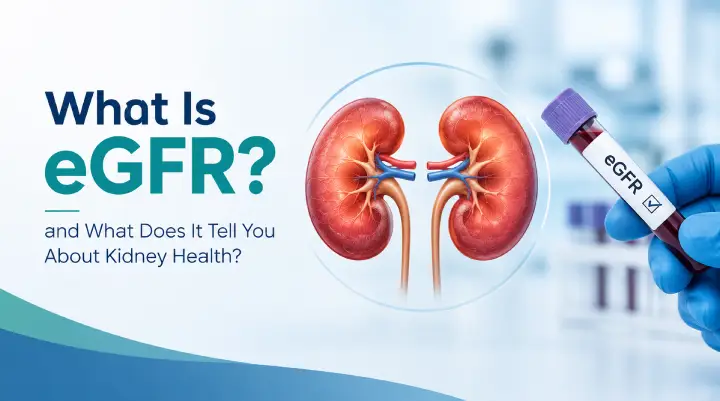
You have had a blood test. The report comes back and somewhere on it, next to a number you have never seen before, are four letters: eGFR. Your doctor has circled it, or flagged it as low, or mentioned it in passing in a way that has left you more confused than reassured.
eGFR — the estimated Glomerular Filtration Rate is arguably the single most important number in kidney medicine. It is the clinical measure of how well your kidneys are filtering blood, and it is the primary tool used to detect kidney disease, stage its severity, monitor its progression, and determine when treatment including dialysis is needed.
Yet despite its clinical centrality, most patients who receive an eGFR result have never heard the term before, do not understand what it measures, and have no framework for interpreting what their specific number means for their long-term health.
This guide changes that. It explains eGFR completely what it is, how it is calculated, what every range means, how it maps to the five stages of chronic kidney disease, what factors affect it, and what you should do based on your result.
Bottom line upfront: A normal eGFR is 90 or above. An eGFR below 60 that persists for more than 3 months indicates Chronic Kidney Disease. An eGFR below 15 signals kidney failure. Every number in between tells a specific clinical story — and this guide helps you read it.
Contents
- 1 What Is GFR — and What Does ‘Estimated’ Mean?
- 2 What Is the Normal eGFR Range?
- 3 eGFR and the 5 Stages of Chronic Kidney Disease
- 4 How Is eGFR Tested? What to Expect
- 5 eGFR Is Not the Whole Story: The Role of Proteinuria
- 6 What Should You Do Based on Your eGFR Result?
- 7 Common Questions About eGFR — Answered
- 8 Who Should Get an eGFR Test — and How Often?
What Is GFR — and What Does ‘Estimated’ Mean?
GFR stands for Glomerular Filtration Rate. To understand it, start with what glomeruli are: the microscopic filtration knots inside each nephron — the functional units of the kidney. Each kidney contains roughly one million nephrons, and each nephron contains one glomerulus: a tiny cluster of capillaries through which blood is filtered under pressure.
The Glomerular Filtration Rate measures how much blood (in millilitres) these glomeruli collectively filter per minute. In a healthy adult, the kidneys filter approximately 90 to 120 millilitres of blood per minute or roughly 120 to 180 litres per day. This filtration capacity is what allows the kidneys to remove waste products (urea, creatinine, uric acid), regulate electrolytes (sodium, potassium, calcium, phosphate), control blood pressure, and produce hormones.
The ‘e’ in eGFR stands for estimated. True GFR can only be measured directly using techniques like inulin clearance or iohexol infusion — complex, expensive procedures used only in research or selected clinical settings. For routine clinical care, GFR is estimated from a simple blood test measuring serum creatinine, combined with patient variables (age, sex, and sometimes race or body size), using validated mathematical equations.
The Equations Behind eGFR
The two most widely used equations are:
- CKD-EPI (Chronic Kidney Disease Epidemiology Collaboration): The current gold standard for adults. More accurate than MDRD across a wider range of GFR values, particularly above 60 ml/min. Increasingly used without a race correction variable (CKD-EPI 2021).
- MDRD (Modification of Diet in Renal Disease): An older equation, still used in many Indian laboratories. Tends to underestimate GFR in people with normal or near-normal kidney function.
The result is reported in ml/min/1.73m² — millilitres per minute, adjusted to a standard body surface area of 1.73 square metres, to allow comparison across people of different sizes. When your lab report says ‘eGFR: 72 ml/min/1.73m²’, this is the number your nephrologist uses to assess where your kidneys stand.
Why creatinine? Creatinine is a waste product of normal muscle metabolism that is filtered exclusively by the glomeruli and not reabsorbed by the tubules — making it an ideal marker of filtration capacity. When kidney function falls, creatinine accumulates in the blood, and the eGFR calculation detects this rise.
What Is the Normal eGFR Range?
Normal kidney function in a healthy young adult produces an eGFR of 90 ml/min/1.73m² or above. However, eGFR is not static — it varies naturally with age, hydration status, muscle mass, diet, and short-term illness. Understanding what is truly normal for your age and context requires interpretation, not just comparison to a fixed cutoff.
How eGFR Changes With Age
eGFR naturally declines with age, even in healthy individuals with no kidney disease. After approximately age 40, eGFR falls by about 0.75 to 1 ml/min per year as part of normal physiological ageing — a process called nephrosclerosis, in which small amounts of glomerular scarring accumulate over decades.
This means:
- A healthy 30-year-old might have an eGFR of 105 ml/min
- A healthy 65-year-old might have an eGFR of 72 ml/min
- A healthy 80-year-old might have an eGFR of 55–65 ml/min
An eGFR of 62 in an 80-year-old with no proteinuria, normal blood pressure, and no urinary abnormalities may represent normal ageing. The same eGFR in a 35-year-old requires urgent investigation. This is why age context is always part of eGFR interpretation — and why a nephrologist evaluates the full picture, not just the number.
What eGFR Numbers Mean at a Glance
- eGFR ≥ 90: Normal or high (normal kidney function, though kidney damage may still be present if proteinuria exists)
- eGFR 60–89: Mildly reduced (may be normal for older adults; requires monitoring and investigation of cause)
- eGFR 30–59: Moderately reduced (Stages 3a/3b CKD — the critical intervention window)
- eGFR 15–29: Severely reduced (Stage 4 CKD — prepare for renal replacement therapy)
- eGFR < 15: Kidney failure (Stage 5 / ESRD — dialysis or transplant required)
Read More :- Chronic Kidney Disease (CKD) in Punjab: Causes, Stages & Best Treatment Centers
eGFR and the 5 Stages of Chronic Kidney Disease
CKD is defined as an eGFR below 60 ml/min/1.73m² persisting for more than 3 months, OR the presence of kidney damage markers (proteinuria, haematuria, structural abnormalities) at any eGFR level. The table below maps eGFR to CKD stage, severity, and clinical meaning.
| Stage | Name | eGFR (ml/min) | Kidney Function | Severity | What This Means for You |
| 1 | Normal with Kidney Damage | ≥ 90 | 90–100% | Normal | Usually no symptoms; kidney damage present (protein/blood in urine). Treat underlying cause, annual monitoring. |
| 2 | Mildly Reduced | 60–89 | 60–89% | Mild | Slightly reduced function; still asymptomatic in most. Lifestyle changes, treat BP/diabetes, 6-monthly review. |
| 3a | Mildly-Moderately Reduced | 45–59 | 45–59% | Moderate | Fatigue, mild anaemia, BP changes may appear. Key window for slowing progression. Nephrologist referral now. |
| 3b | Moderately-Severely Reduced | 30–44 | 30–44% | Moderate | Significant decline. Anaemia, electrolyte changes, bone disease may develop. Prepare for renal replacement therapy. |
| 4 | Severely Reduced | 15–29 | 15–29% | Severe | Major symptoms. Uraemia risk. Dialysis or transplant planning must begin. Urgent nephrology management. |
| 5 | Kidney Failure (ESRD) | < 15 | < 15% | Failure | End-Stage Renal Disease. Dialysis or kidney transplant required to sustain life. Active RRT management. |
Most patients are not diagnosed until Stage 3 or later — when symptoms begin to emerge. Stages 1 and 2 are almost always caught only through routine screening. This is why annual eGFR testing for at-risk individuals is one of the most important preventive health measures available.
How Is eGFR Tested? What to Expect
Measuring eGFR is simple, inexpensive, and requires only a blood test. Here is what the process looks like:
The Test Itself
A standard serum creatinine test is performed from a blood sample drawn from a vein. No special preparation is required for a routine eGFR — though some laboratories recommend avoiding very high protein meals (especially red meat) in the 12 hours before testing, as they can transiently raise creatinine levels and artificially lower eGFR.
The laboratory reports serum creatinine in mg/dL or μmol/L, and then automatically calculates eGFR using the CKD-EPI or MDRD equation, factoring in the patient’s age and sex (and sometimes race, depending on which equation version is used).
What Affects eGFR Results
Several factors can influence a single eGFR reading — understanding them prevents unnecessary alarm or false reassurance:
- Muscle mass: Creatinine is produced by muscles. People with high muscle mass (athletes, bodybuilders) naturally have higher creatinine and may show lower eGFR than their true filtration rate. People with low muscle mass (elderly, malnourished) may have falsely normal eGFR despite reduced kidney function.
- Diet: A large red meat meal in the hours before testing can transiently raise creatinine and lower eGFR. Vegetarians and vegans tend to have slightly lower creatinine at any given GFR.
- Dehydration: Significant dehydration concentrates creatinine in the blood, producing a falsely low eGFR that corrects with rehydration.
- Acute illness: Fever, infection, surgery, or any major physical stress can temporarily reduce kidney filtration and lower eGFR, which recovers when the illness resolves.
- Medications: NSAIDs (ibuprofen, diclofenac), ACE inhibitors, ARBs, and contrast agents can cause transient eGFR changes. These are usually reversible but require monitoring.
- Sex: Women naturally have lower muscle mass and therefore lower creatinine at the same kidney function as men — the equations account for this.
A single abnormal eGFR is not a diagnosis. CKD requires the abnormality to persist for more than 3 months. If your eGFR comes back low unexpectedly, recheck it in 2–4 weeks after ensuring adequate hydration and avoiding NSAIDs. If it remains low, seek nephrologist evaluation.
eGFR Is Not the Whole Story: The Role of Proteinuria
eGFR is the primary marker of kidney filtration capacity, but it does not provide the complete picture of kidney health. Equally important — and often diagnosed earlier — is proteinuria: the presence of protein in the urine, indicating that the glomerular filtration membrane has been damaged and is leaking protein (primarily albumin) that should remain in the blood.
The clinical measure of proteinuria used in nephrology practice is the Urine Albumin-to-Creatinine Ratio (UACR or ACR), measured from a spot urine sample:
- ACR < 3 mg/mmol (or < 30 mg/g): Normal
- ACR 3–30 mg/mmol (or 30–300 mg/g): Moderately increased (previously called microalbuminuria) — earliest sign of kidney damage in diabetes
- ACR > 30 mg/mmol (or > 300 mg/g): Severely increased (macroalbuminuria / overt proteinuria) — significant glomerular damage
A patient can have a normal eGFR (above 60) but still have CKD if they have persistent significant proteinuria — because proteinuria itself is a marker of kidney damage and a strong independent predictor of CKD progression and cardiovascular events. This is why modern CKD classification uses both eGFR and albuminuria category together, not eGFR alone.
If your eGFR is normal but your urine test shows persistent protein or foam — do not ignore it. A urine ACR should be performed and reviewed by a nephrologist. Early proteinuria with a normal eGFR is Stage 1 CKD — the optimal time to intervene.
What Should You Do Based on Your eGFR Result?
eGFR ≥ 90 (Normal / Stage 1 with damage markers)
If your eGFR is 90 or above, your kidney filtration capacity is normal or high. However, if proteinuria or haematuria is also present, you may still have Stage 1 CKD — kidney damage with preserved function. Action: identify and address the underlying cause (diabetic nephropathy, glomerulonephritis, hypertension); lifestyle optimisation; annual retesting.
eGFR 60–89 (Stage 2 — Mildly Reduced)
An eGFR in this range may be normal for your age, or may represent early CKD. Action: ensure good BP control (below 130/80 mmHg); check urine ACR; if diabetic, tighten sugar control; retest in 3 months to establish trend. Referral to nephrology if proteinuria is present or eGFR is declining.
eGFR 30–59 (Stages 3a/3b — Moderate CKD) — Act Now
This is the most clinically critical range in terms of intervention opportunity. eGFR in this range represents 30–60% kidney function — enough to be asymptomatic in many patients, but little enough that the trajectory toward advanced CKD is already set. This is where treatment makes the most difference.
Action: referral to nephrologist is essential; initiate or intensify RAAS blockade (ACE inhibitor or ARB); consider SGLT2 inhibitor if diabetic; dietary sodium restriction; avoid NSAIDs and nephrotoxic substances; annual or biannual monitoring of eGFR, electrolytes, haemoglobin, phosphate, and parathyroid hormone.
eGFR 15–29 (Stage 4 — Severely Reduced)
At this stage, preparation for renal replacement therapy (dialysis or transplant) becomes essential, even if the patient still feels well. Symptoms of uraemia may begin. Action: nephrologist-led management is mandatory; vascular access creation (AV fistula) should be initiated now, as it takes weeks to months to mature; assess for transplant eligibility; manage anaemia with EPO therapy; strict dietary management.
eGFR < 15 (Stage 5 / ESRD — Kidney Failure)
At this stage, the kidneys can no longer sustain life without external support. Dialysis or transplantation is required. Action: immediate nephrology care; dialysis initiation if not already started; ongoing transplant assessment for eligible patients.
If your eGFR falls below 60 for the first time — or if it has dropped more than 5 ml/min in the past 12 months — book a nephrology appointment urgently. Rate of decline matters as much as absolute value. A rapidly falling eGFR requires immediate investigation.
Read More :- Nephrologist vs Urologist: Which Kidney Specialist Should You See?
Common Questions About eGFR — Answered
These are the questions most frequently asked in nephrology clinic. The answers reflect current clinical evidence and practice guidelines.
| Question | Nephrologist’s Answer |
| Can eGFR improve? | Yes — especially if the cause of decline (dehydration, AKI, uncontrolled diabetes/BP) is treated promptly. In CKD, progression can be slowed significantly with treatment, though lost nephron mass does not regenerate. |
| Is one low eGFR result enough to diagnose CKD? | No. CKD requires an eGFR below 60 (or kidney damage markers) persisting for more than 3 months. A single low reading may reflect acute illness, dehydration, or lab variation. Repeat testing at 3 months is essential. |
| My eGFR is 58 — should I panic? | No, but you should act. An eGFR of 58 (Stage 3a) is the point where nephrology referral and lifestyle intervention can most effectively slow progression. Early action here dramatically improves long-term outcomes. |
| Does eGFR decline with age normally? | Yes — eGFR naturally decreases by approximately 0.75–1 ml/min/year after age 40. This is why age-adjusted interpretation matters. An eGFR of 62 in a healthy 80-year-old is different from the same value in a 35-year-old. |
| Can medications affect eGFR? | Yes. NSAIDs (ibuprofen, diclofenac), contrast agents, aminoglycoside antibiotics, and some blood pressure medications (ACE inhibitors, ARBs) can cause transient eGFR changes. Always inform your nephrologist of all medications. |
| Is eGFR the same as creatinine clearance? | They measure related but different things. Creatinine clearance (from a 24-hour urine collection) measures actual GFR directly. eGFR is an estimate calculated from serum creatinine using validated equations — more practical for routine testing. |
Who Should Get an eGFR Test — and How Often?
Because CKD is largely asymptomatic in its early stages, targeted screening is essential. Annual eGFR testing is recommended for:
- All patients with Type 1 or Type 2 diabetes — from diagnosis onwards
- All patients with hypertension — from diagnosis onwards
- Adults over 60 years of age — especially with additional risk factors
- People with a family history of kidney disease, CKD, or polycystic kidney disease
- People who are obese (BMI > 30) or have metabolic syndrome
- Patients with recurrent kidney stones or urinary tract infections
- People who take NSAIDs, lithium, or other nephrotoxic medications regularly
- Anyone with a history of Acute Kidney Injury (AKI)
- Individuals in areas with known heavy metal or pesticide contamination in water supply
For patients already diagnosed with CKD, the frequency of eGFR monitoring depends on stage and rate of progression. Stable Stage 3 CKD typically requires testing every 3–6 months; Stage 4–5 every 1–3 months, with more frequent monitoring of electrolytes and haemoglobin.
Dr. Deepali Kaushal
Consultant – Nephrology & Transplant Medicine | Dhiman’s Gastro Clinics, Khanna, Punjab
DM – Nephrology
11+ Years Experience
Kidney Biopsy
Dialysis & CRRT
Transplant Follow-up
The clinical guidance in this blog reflects the expertise of Dr. Deepali Kaushal — one of Punjab’s most respected Consultants in Nephrology and Transplant Medicine at Dhiman’s Gastro Clinics, Khanna. With over 11 years of dedicated experience and DM Nephrology qualifications, Dr. Kaushal specialises in early detection and comprehensive management of kidney disease at every severity level — from interpreting a first abnormal eGFR to managing end-stage renal disease with dialysis and post-transplant immunosuppression. If your eGFR has been flagged as low, or you have risk factors and have not been screened, Dr. Kaushal’s clinic provides expert nephrology care serving patients from across Punjab.


 Call Us
 WhatsApp
 Locate Us