
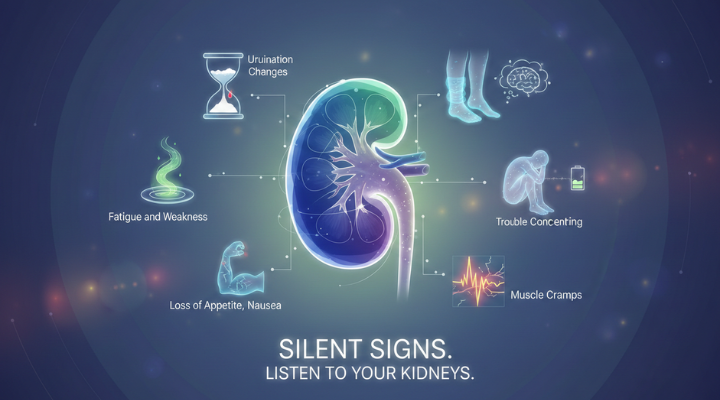
Ask most people what kidney disease looks like and they will mention one thing: changes in urine blood in the urine, foamy urine, or reduced output. And while urinary changes are indeed important warning signs, they represent only one piece of a much larger picture.
The uncomfortable truth about kidney disease is that it is a master of disguise. Chronic kidney disease (CKD) can silently rob your kidneys of 50, 60, even 70 percent of their function before producing any symptoms obvious enough to send you to a doctor. By the time most patients are diagnosed, significant and often irreversible damage has already been done.
This is why learning to recognise the subtler, less obvious signals your body sends is so important. Your kidneys communicate distress through symptoms that appear completely unrelated to the urinary system in your skin, your breath, your muscles, your mind, and your energy levels.
Here are seven silent signs of kidney disease that have nothing to do with urine, and everything to do with how well your body is functioning as a whole.
Contents
- 1 Quick Reference: 7 Silent Signs at a Glance
- 1.1 Sign 1: Persistent Fatigue and Unexplained Weakness
- 1.2 Sign 2: Swelling in the Face, Hands, Feet or Ankles
- 1.3 Sign 3: Shortness of Breath Without Cardiac Cause
- 1.4 Sign 4: Persistent Itching Across the Body
- 1.5 Sign 5: Loss of Appetite, Nausea and a Metallic Taste
- 1.6 Sign 6: Muscle Cramps and Restless Leg Syndrome
- 1.7 Sign 7: Difficulty Concentrating and ‘Brain Fog’
- 2 About Dr. Deepali Kaushal
- 3 The Bottom Line: Listen When Your Body Whispers
Quick Reference: 7 Silent Signs at a Glance
Use this table to identify warning signs early. If two or more of these apply to you — especially alongside risk factors like diabetes or hypertension — consult a nephrologist promptly.
| # | Silent Sign | What It Feels Like | Why the Kidneys? | When to Act |
| 1 | Persistent Fatigue & Weakness | Bone-deep tiredness unrelieved by rest; difficulty concentrating | Anaemia from low erythropoietin; toxin build-up in blood | If fatigue lasts more than 2–3 weeks without explanation |
| 2 | Swelling in Face, Hands or Ankles | Puffiness around eyes in the morning; tight shoes by evening | Kidneys failing to remove excess fluid and sodium | Any unexplained swelling, especially with high BP |
| 3 | Shortness of Breath | Breathlessness on mild exertion or even at rest | Fluid in lungs (pulmonary oedema) or anaemia reducing oxygen delivery | Immediately — this can be an emergency |
| 4 | Persistent Itching (Pruritus) | Intense itching all over the body, worse at night, no rash | Phosphate and uremic toxins accumulate when kidneys cannot filter them | If itching is widespread and unresponsive to creams |
| 5 | Loss of Appetite & Metallic Taste | Food tastes like metal or ammonia; nausea; unexplained weight loss | Uraemia — urea and creatinine accumulate, altering taste receptors | If lasting more than a week, especially with nausea |
| 6 | Muscle Cramps & Restless Legs | Sudden painful cramps, especially at night; irresistible urge to move legs | Electrolyte imbalances — low calcium, phosphate build-up, nerve irritation | If frequent and disrupting sleep regularly |
| 7 | Difficulty Concentrating &’Brain Fog’ | Poor memory, inability to focus, feeling mentally slow or confused | Toxin accumulation affects brain function (uraemic encephalopathy) | If cognitive changes appear alongside fatigue or swelling |
Read More :- How Much Water Is Really Enough for Your Kidneys?
Sign 1: Persistent Fatigue and Unexplained Weakness
Fatigue is one of the earliest and most frequently overlooked signs of declining kidney function. It is not the ordinary tiredness that follows a poor night’s sleep — it is a bone-deep exhaustion that persists regardless of rest, often accompanied by difficulty concentrating and a general sense of physical heaviness.
Two mechanisms explain why failing kidneys cause fatigue. First, healthy kidneys produce erythropoietin (EPO), a hormone that signals the bone marrow to produce red blood cells. When kidney function declines, EPO production falls, leading to anaemia — fewer red blood cells to carry oxygen to muscles and organs. Second, as the kidneys lose their filtering capacity, waste products including urea and creatinine accumulate in the blood, directly impairing cellular energy production throughout the body.
Many patients attribute this fatigue to stress, poor sleep, or ageing — delaying diagnosis by months or even years. If you have been feeling chronically exhausted without a clear cause, particularly if you have risk factors for kidney disease, a simple blood test measuring your kidney function and haemoglobin level can be revealing.
⚠ Kidney-related fatigue is often accompanied by pallor (pale skin), dizziness on standing, and a rapid heartbeat — signs of anaemia that warrant immediate testing.
Sign 2: Swelling in the Face, Hands, Feet or Ankles
Oedema — fluid retention causing visible swelling — is one of the most telling signs that the kidneys are struggling, yet it is routinely misattributed to standing too long, hot weather, or ageing joints.
The kidneys regulate the body’s fluid and sodium balance with extraordinary precision. When they lose this capacity, sodium and water accumulate in the tissues. Swelling typically begins subtly: puffiness around the eyes in the morning, rings that feel suddenly tight, or shoes that are difficult to put on by the end of the day. Over time, it can progress to visible swelling of the lower legs and ankles.
A particularly significant form of oedema in kidney disease is periorbital oedema — swelling around the eyes, especially on waking. This occurs because protein leaking into the urine (proteinuria) reduces the blood’s ability to hold fluid in the vessels, causing it to seep into surrounding tissues. If you notice consistent facial puffiness that improves through the day, it warrants a urine test for protein.
Sign 3: Shortness of Breath Without Cardiac Cause
Unexpected breathlessness — finding yourself short of breath during activities that previously caused no difficulty, or even while sitting still — can be a serious sign of kidney disease that is frequently mistaken for a heart or lung problem.
Two kidney-specific mechanisms cause respiratory symptoms. The first is pulmonary oedema: when the kidneys fail to remove excess fluid, it can accumulate in the lungs, making breathing feel laboured and difficult — a condition that can become life-threatening rapidly. The second is anaemia from kidney disease reducing the oxygen-carrying capacity of the blood, so even mild exertion triggers breathlessness.
Additionally, in advanced kidney failure, the blood becomes acidic (metabolic acidosis), and the body compensates by breathing faster and more deeply to expel carbon dioxide — a pattern called Kussmaul breathing. Any unexplained shortness of breath, particularly in someone with diabetes or hypertension, should be investigated as a potential kidney emergency.
⚠ Sudden severe breathlessness with swollen legs in a patient with known kidney disease is a medical emergency. Seek immediate care.
Sign 4: Persistent Itching Across the Body
Widespread, persistent itching — medically called uraemic pruritus — is one of the most distressing and least understood symptoms of kidney disease. Patients describe it as an intense, unrelenting itch that no cream, lotion, or antihistamine can touch, often worse at night and with no visible rash or skin change.
The mechanism is the accumulation of phosphate and other uremic toxins in the bloodstream when the kidneys can no longer filter them effectively. These substances deposit in the skin and activate itch receptors in the nervous system. In some cases, secondary hyperparathyroidism — a hormonal imbalance triggered by kidney disease — also contributes by altering calcium and phosphate levels in the skin.
Uraemic pruritus is particularly prevalent in patients with moderate to advanced CKD and those on dialysis. It is almost always mismanaged as a dermatological problem for months before the kidney connection is made. If you experience generalised itching that does not respond to standard treatments, a kidney function test is essential.
Sign 5: Loss of Appetite, Nausea and a Metallic Taste
When the kidneys fail to clear waste products from the blood, a condition called uraemia develops — literally ‘urine in the blood.’ Among its most common manifestations are digestive symptoms: a persistent loss of appetite, waves of nausea (particularly in the morning), occasional vomiting, and a distinctive metallic or ammonia-like taste in the mouth.
The metallic taste occurs because bacteria in the saliva convert urea — which accumulates in high concentrations in kidney failure — into ammonia. Patients often report that food tastes ‘off’, that their breath has an unusual smell, or that they have simply stopped feeling hungry. This progressive anorexia can lead to significant unintended weight loss, muscle wasting, and malnutrition that further worsens overall prognosis.
These symptoms are frequently attributed to gastritis, acidity, or stress — common diagnoses in general practice that can mask an underlying kidney problem. If digestive symptoms coincide with fatigue, swelling, or any change in urine output, kidney function tests should be among the first investigations requested.
Sign 6: Muscle Cramps and Restless Leg Syndrome
Painful, involuntary muscle cramps — particularly in the calves and legs, most often occurring at night — are a classic but underrecognised symptom of kidney disease. They arise from the electrolyte imbalances that develop as kidney function deteriorates: low calcium, elevated phosphate, and abnormal sodium and potassium levels directly disrupt the electrical signals that control normal muscle contraction and relaxation.
Restless leg syndrome (RLS) — an irresistible, deeply uncomfortable urge to move the legs, typically worse in the evening and at rest — affects a significant proportion of patients with CKD and those on dialysis. The exact mechanism involves iron deficiency, anaemia, nerve irritation from accumulated toxins, and dopamine pathway disruption. RLS severely disrupts sleep, compounding the fatigue and cognitive difficulties that kidney disease already causes.
If you experience frequent nocturnal cramps or restless legs alongside any other symptom on this list, mention it explicitly to your doctor — these connections are not always made automatically in a general consultation.
Sign 7: Difficulty Concentrating and ‘Brain Fog’
Cognitive impairment in kidney disease — often described by patients as ‘brain fog’, difficulty finding words, poor short-term memory, or an inability to concentrate on tasks that were previously effortless — is among the most underdiagnosed manifestations of declining renal function.
When waste products that the kidneys normally clear accumulate in the blood, they cross the blood-brain barrier and interfere directly with neurological function. This is termed uraemic encephalopathy, and it exists on a spectrum — from mild difficulty concentrating in early CKD, to confusion and disorientation in advanced disease, to seizures and coma in end-stage kidney failure.
Anaemia compounds cognitive symptoms by reducing the oxygen supply to the brain. Studies have shown that patients with moderate CKD perform measurably worse on tests of memory, processing speed, and executive function compared to age-matched healthy individuals — yet cognitive symptoms are almost never the presenting complaint that leads to a kidney diagnosis.
If you or a family member notices progressive cognitive changes — especially alongside physical symptoms like swelling, fatigue, or reduced urine output — kidney function should be evaluated as part of the work-up.
About Dr. Deepali Kaushal
Consultant – Nephrology & Transplant Medicine | Dhiman’s Gastro Clinics, Khanna, Punjab
The seven silent signs described in this blog are drawn from the clinical experience of Dr. Deepali Kaushal — a leading Consultant in Nephrology and Transplant Medicine at Dhiman’s Gastro Clinics, Khanna, Punjab. Holding advanced qualifications in MD (Internal Medicine) and DM Nephrology, and with over 11 years of dedicated expertise in kidney care, Dr. Kaushal is widely regarded as one of the best kidney specialists in Punjab. Her practice encompasses the full breadth of nephrology: Chronic Kidney Disease (CKD), Acute Kidney Injury (AKI), diabetic nephropathy, glomerular and autoimmune kidney disorders, resistant hypertension, hemodialysis, peritoneal dialysis, CRRT, renal biopsy, and comprehensive post-transplant follow-up and care. What sets Dr. Kaushal apart is not only her clinical depth, but her unwavering commitment to patient education — helping individuals recognise warning signs early, understand their diagnosis clearly, and make informed decisions about their kidney health. If you have experienced any of the symptoms described in this article, or if you are at risk due to diabetes, hypertension, or a family history of kidney disease, an early consultation with Dr. Deepali Kaushal at Dhiman’s Gastro Clinics could be one of the most important health decisions you make. Early diagnosis, in kidney disease, is not just advantageous — it is often life-changing.
The Bottom Line: Listen When Your Body Whispers
Kidney disease rarely shouts. It whispers through tiredness that won’t lift, ankles that won’t stop swelling, skin that won’t stop itching, and a mind that won’t stay sharp. Each of these seven signs, in isolation, is easy to explain away. Together, or in the presence of known risk factors, they form a picture that demands medical attention.
The earlier kidney disease is caught, the more options exist from lifestyle changes and medication to slow its progression, to protecting the kidneys from further damage. Once kidneys reach end-stage failure, dialysis or transplantation become the only remaining paths.
Do not wait for obvious symptoms. Do not wait until the damage is done. If any of the signs in this article resonate with your own experience, book a kidney function test and speak with a nephrologist. Your kidneys have been silently protecting you your entire life — the least you can do is listen when they finally speak.
“Kidney disease speaks in a language most people have never been taught to hear. Learning that language can save your life.”
Read More :- 7 Golden Rules for Kidney Health By the Best Kidney Doctor in Punjab

 Call Us
 WhatsApp
 Locate Us